
Generative AI for Sales Teams: A Practical Guide to Real Use Cases
Most of what you've read about generative AI for sales teams is either breathless hype or vague abstraction. "AI will transform your sales org." Great. How?
This guide is for the sales enablement leader who's past the "should we use AI" question and is now asking the harder one: where does it actually create value, and how do you roll it out without creating more chaos than it solves?
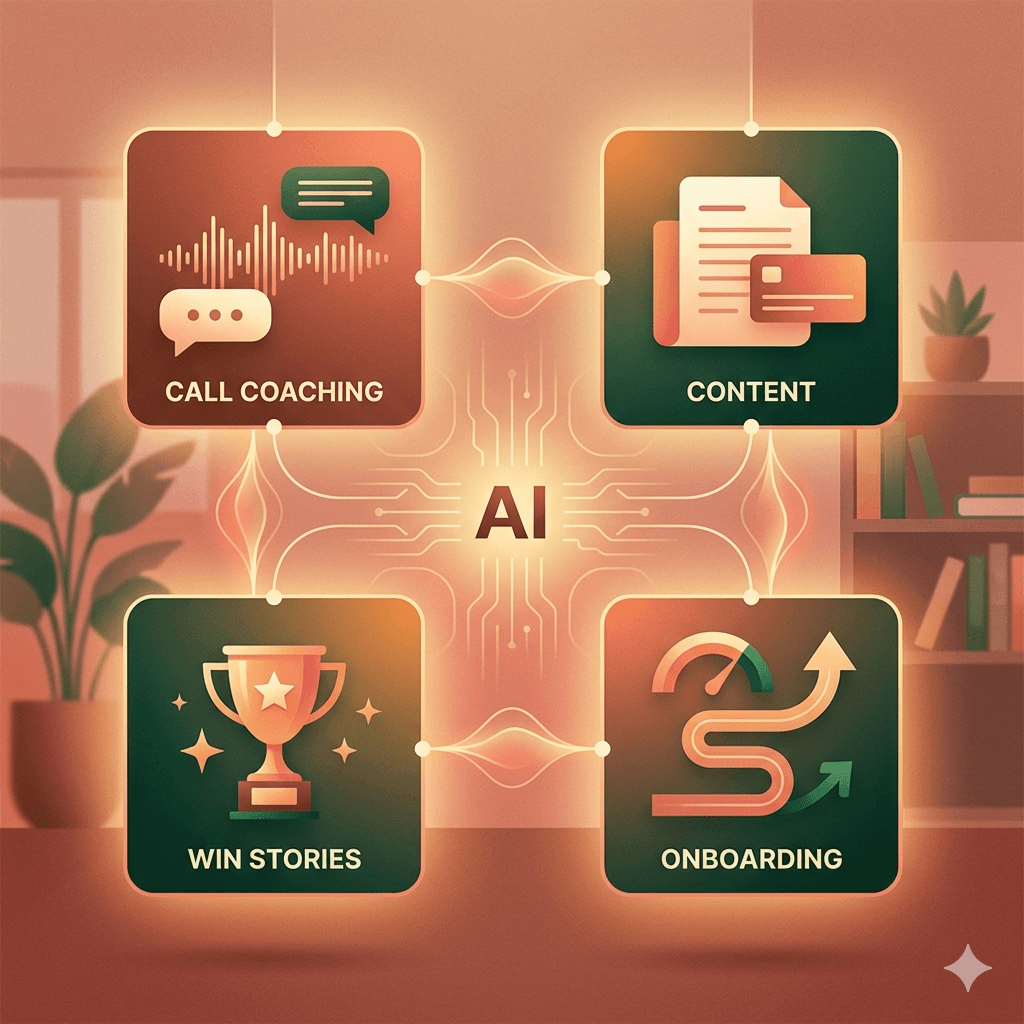
We'll walk through four use cases that are working right now — call coaching, content generation, win story analysis, and onboarding acceleration — with specifics on what good looks like, where teams get stuck, and what to expect in terms of time and outcomes.
Why Generative AI Finally Matters for Sales Enablement
Sales enablement has been "automating" for years. CRMs logged activity. LMS platforms served training. Content portals stored decks. But the work of enablement — coaching reps, creating relevant content, surfacing what's working — stayed stubbornly manual.
Generative AI changes that because it can finally do the work, not just store the outputs of the work. It can listen to 50 calls and tell you what your top performers say differently. It can draft a new battlecard in your company voice. It can take a messy win story and turn it into a polished case study.
That's the shift. Not "AI-powered analytics" in a dashboard. AI that produces the artifacts enablement teams used to spend hours building.
The catch: AI is only as good as the context you give it. A generic ChatGPT prompt will produce generic output. The teams getting real value are the ones putting AI inside their sales content, call libraries, and CRM data — not bolting it on the side.
Use Case 1: AI for Call Coaching
Every sales leader knows coaching is the single highest-leverage activity for improving rep performance. Every sales leader also knows their managers don't have time to do it well.
The math is brutal. A frontline manager with eight reps would need to listen to hundreds of calls a month to coach effectively. In practice, most managers review a handful of deals before 1:1s and call it coaching.
What AI Can Actually Do Here
Modern AI can analyze every call a rep makes and produce structured feedback against your methodology. Not just a transcript summary — real coaching signal.
Talk-time ratios, monologue length, and question-asking rates by call stage
Detection of discovery framework adherence (MEDDIC, BANT, Command of the Message, whatever you run)
Identification of missed objections, unanswered questions, and skipped next-step confirmations
Comparison of a rep's call patterns against top performers on the same team
How to Roll This Out
Don't start by trying to score every call on every dimension. Pick one coaching focus — say, "discovery questions per call" — and use AI to establish a baseline. Show reps their numbers next to the team average. Then coach against it for 30 days and measure the delta.
The trap to avoid: treating AI-generated coaching as a replacement for manager conversations. Reps ignore automated feedback that isn't reinforced in a human context. The best teams use AI to surface what to coach on, then have the manager do the actual coaching conversation.
What to Expect
Teams that implement AI call coaching well typically see measurable movement in the metric they target within 60-90 days. The bigger unlock is manager leverage — a manager who used to spot-check four calls a week can now coach against patterns across every call their team makes.
Use Case 2: AI for Content Generation
Sales content is enablement's most visible deliverable and also its most frustrating. You build a battlecard, it gets stale in three months. You write a one-pager, it doesn't get used because it's too generic. You update the pitch deck, nobody tells the field.
Generative AI doesn't solve the governance problem. But it does collapse the production cost of content to something like 10% of what it used to be — which changes what's economical to create and maintain.
Where It Works
Competitive battlecards. Feed AI your product docs, recent win/loss transcripts, and the competitor's public positioning. It can draft a battlecard that reflects how your reps actually beat this competitor, not how marketing thinks you should.
Persona-specific messaging. Take one core message and have AI adapt it for a CFO, a VP Engineering, and a Head of Ops. Each version gets the angle and vocabulary that persona cares about.
Call follow-up emails. AI can turn a call transcript into a personalized follow-up that references actual statements, next steps, and open questions from the conversation.
Objection handling guides. Pull the objections that actually came up in last quarter's losses, then draft response frameworks grounded in your real product and proof points.
The Voice Problem
The number one complaint about AI-generated content is that it sounds like AI. Generic, over-formal, full of corporate hedge words.
The fix is context. AI tools that pull from your existing top-performing content produce output that sounds like your company because it's trained on your company. Generic AI tools require extensive prompt engineering to get there, and even then they drift.
This is one of the clearest arguments for AI that lives inside your enablement platform rather than AI you access through a separate tab. The platform knows your voice because it owns your content library.
Use Case 3: Win Story Capture and Analysis
Ask any enablement leader where the best sales knowledge in their company lives, and they'll tell you the same thing: in the heads of their top three reps.
That knowledge almost never makes it to the rest of the team. Sometimes someone organizes a "wins review" meeting. Occasionally a rep gets featured in a kickoff panel. Mostly, the specific moves that won a deal — the reframe, the proof point, the trap set for the competitor — die with the deal.
How AI Changes This
AI can extract win patterns from call recordings and CRM data without anyone having to write anything up. Point it at a set of closed-won deals and ask: what did reps say differently in the discovery call versus deals we lost? What objections came up that weren't handled in our playbook?
This is one of the places where generative AI is genuinely new capability, not an incremental improvement. You could not do this before without an army of analysts.
Turning Patterns Into Peer Learning
Extracting the pattern is step one. The real leverage is turning those patterns into artifacts the rest of the team can learn from.
A short clip of a top rep handling a specific objection, labeled and searchable. A teardown of how a champion was developed across five calls. A library of "this is what good sounds like" organized by deal stage.
Peer-to-peer learning works in sales because reps trust other reps more than they trust formal training. AI makes peer learning scalable because it can identify and package the moments worth learning from — which nobody has time to do manually.
Use Case 4: Onboarding Acceleration
Ramp time is the number most sales leaders wish they could cut in half. The average for B2B SaaS sits somewhere between four and nine months depending on deal complexity. Every week you shave off is revenue pulled forward.
Traditional onboarding front-loads information. New reps get firehosed with product training, methodology training, systems training, compliance training — then they're told to go sell. By week six, they've forgotten 70% of it.
What AI Makes Possible
On-demand answers. A new rep in a live deal can ask a question in natural language and get an answer pulled from your actual sales content, not a generic search result.
Personalized learning paths. Based on a rep's background and early performance, AI can sequence training differently for someone coming from a BDR role versus an experienced AE who switched industries.
Role-play simulation. AI can play the role of a prospect with specific objections and personas, giving reps reps (the other kind) without tying up a manager.
Real-time readiness signals. Instead of a static certification, AI can assess whether a rep is actually ready for a specific deal stage based on call quality and content comprehension.
The Shift in How Onboarding Works
The biggest change is philosophical. Old onboarding was "teach them everything, then let them sell." AI-enabled onboarding is "let them sell, and give them answers exactly when they need them."
That only works if answers are actually at hand. Which means your content has to be organized, searchable, and accurate. AI doesn't fix a messy content library — it makes the mess more visible.
What to Do Before You Buy Anything
If you're evaluating generative AI for sales, resist the urge to pilot five tools at once. You'll create tool sprawl in the name of fixing tool sprawl.
A few practical steps first:
Pick one use case with a clear metric. Call coaching adherence, ramp time, or content usage are all reasonable starting points. Don't start with "general productivity."
Audit your content library. AI that pulls from garbage produces garbage. Before you automate content generation, know what you have and what's current.
Map where your reps actually work. If your team lives in Salesforce, Gong, and Slack, AI that requires them to open a new tab will not get used. The winning tools meet reps in their existing workflow.
Decide what you're willing to consolidate. Most enablement teams run four to seven tools. If you're adding AI on top of all of them, you're making the problem worse. If a unified platform can replace three of those tools and add AI natively, the math is very different.
Where Flockjay Fits
We built Flockjay because we watched enablement teams try to stitch generative AI onto a stack of seven tools and get nowhere. The AI couldn't see the content, the content couldn't see the calls, the calls couldn't see the CRM. Everyone was "AI-powered" in theory and fragmented in practice.
Flockjay is a unified LMS and CMS with generative AI built in — one platform where your content, your learning, your call intelligence, and your peer knowledge all live together. Because the AI has context across everything, it can do the things described above without five integrations and a data engineering project.
That includes call coaching against your methodology, content generation in your company voice, win story capture that surfaces what top performers actually do differently, and onboarding that adapts to the rep. Plus 50+ integrations with the tools you're already running — Salesforce, Gong, Slack, Teams — so nothing gets orphaned.
If the four use cases in this guide sound like what you've been trying to piece together, we're worth a conversation.